

What K = 1.0 actually means
Marsh
People talk about K-factor crossing 1.0 as "viral." What does that actually mean numerically?
Mallow
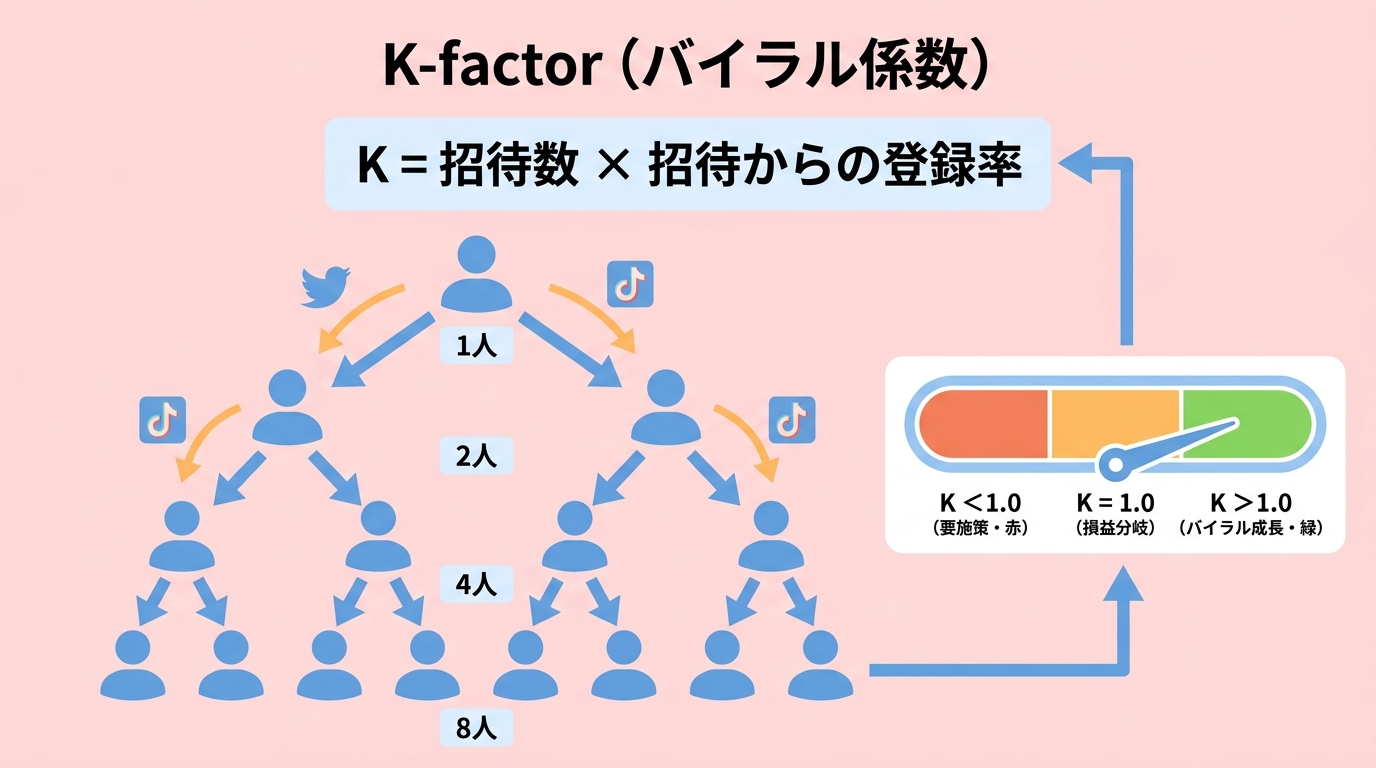
Every existing player brings in one or more new players through invites or word of mouth. With 100 users at K = 1.0, the next cycle is +100, the cycle after is +200, and so on. Growth without paid acquisition.
Marsh
So if K is below 1.0, the game can't grow on its own?
Mallow
Not purely from virality. K < 1 means each cohort produces fewer than one new user via invites, so the next generation is smaller. Eventually it converges to zero new users without an external input. Paid acquisition is required to keep growth going.
Marsh
Do any Roblox titles actually hit 1.0?
Mallow
Top tier does. Median is 0.2–0.5. Most titles run on a mix of paid traffic and virality. Even K = 0.5 means "half of every paid acquisition pays for the next user," which is meaningful for CAC math.
Marsh
What levers actually pull K up on Roblox?
Mallow
Co-Play mechanics are the strongest on Roblox — "2x rewards when playing with friends," guild-only content, co-play-exclusive bosses. Plus the Share button and friend-invite UI flow. By 2026, Roblox clips on TikTok and YouTube Shorts are also a growing source — engineering a shareable moment helps.
Formula & benchmarks
K-factor = Invites per user × invite-to-signup conversion rate
- Under 0.2: Negligible virality — growth is entirely paid + algorithm
- 0.2–0.5: Roblox median range — virality contributes meaningfully but doesn't carry growth alone
- 0.5–0.9: Strong — paid spend becomes much more efficient
- 1.0+: Self-sustaining viral growth (rare; top tier)
Worked example
Marsh
Last month, our 5,000 monthly actives sent 1,500 friend invites. Of those, 600 actually joined. What's our K?
Mallow
Invites per user = 1,500 ÷ 5,000 = 0.3. Invite-to-signup = 600 ÷ 1,500 = 40%. K = 0.3 × 0.4 = 0.12. Below median. Most of your growth still has to come from paid or algorithm.
Marsh
If we doubled invites per user via a Co-Play reward, K goes to 0.24. What's the practical impact?
Mallow
If CPI (cost per install) is $0.50, every paid user now drags 0.24 free users with them. Effective CPI drops to about $0.40. Across a $10K spend, that's 5,000 extra users you'd otherwise have paid for. K-factor compounds budget.
Marsh
What's the single best lever to double our invites-per-user?
Mallow
A 2x reward for playing with at least one friend. Single mechanic, immediate behavior change. Brand experiences often skip this because "rewards" feel mercenary — but co-play participation is one of the highest-correlation signals in Roblox 2026's algorithm.
Reading it in Roblox
Creator Hub doesn’t surface K-factor directly. Compute it from: (a) the Sharing / Friend Invites count in the Acquisition section, divided by total actives, multiplied by (b) the invite-to-signup conversion (visible in Acquisition Source breakdown as “Friend Invite”). External analytics tools surface K as a single metric. Note: Roblox’s algorithm-driven discovery means even at low K, viral-style growth can happen via the recommendation feed — that’s not technically K-factor but it’s adjacent and worth tracking together.
Common misconceptions
- "K = 1.0 means infinite growth" isn't quite right: K usually decays over time as the most "invitable" users get tapped out. Initial K above 1 still trends down toward the steady state.
- K-factor isn't the same as "going viral": TikTok virality is a one-time external traffic event. K-factor is the sustained in-product invite mechanic. They contribute differently.
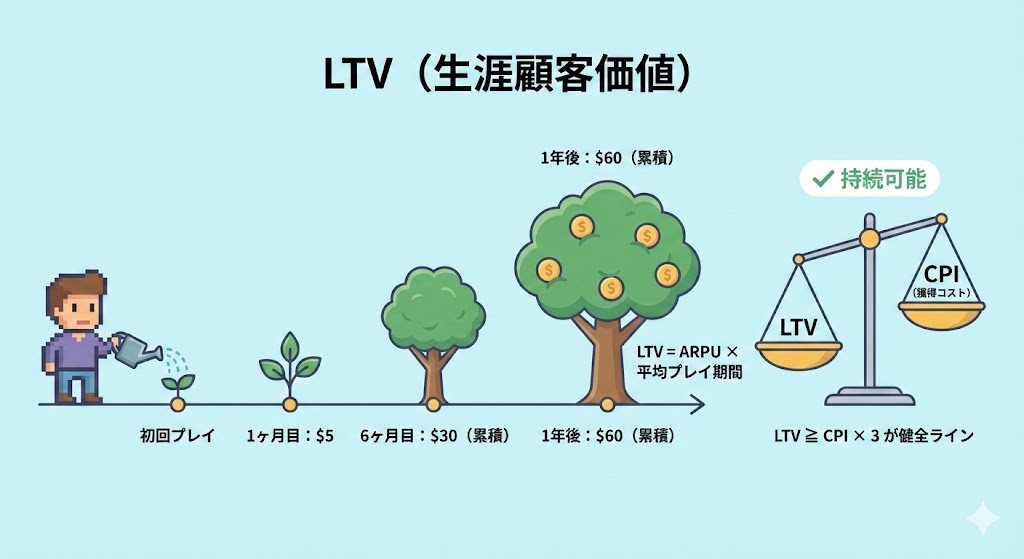
- Low K isn't a failure if paid math works: If LTV/CAC is healthy on paid, low K is fine. K becomes critical when paid acquisition gets expensive or saturates.
Related metrics
- CAC: Cost to acquire one user. Higher K-factor lowers effective CAC
- Conversion Rate: The invite-to-signup component sits inside K
- Co-Play Days: A social metric Roblox's 2026 algorithm reportedly weights
- LTV: K + LTV/CAC together determine sustainable growth