

What D1 actually means
Marsh
D1 Retention is basically "share of players who came back the next day." Is that one number really that important?
Mallow
Yes — that important. Whether a first session made someone think "I want to play again" shows up inside a 24-hour window. Roblox's recommendation algorithm is widely understood to weight this signal heavily.
Marsh
What number should I be aiming for?
Mallow
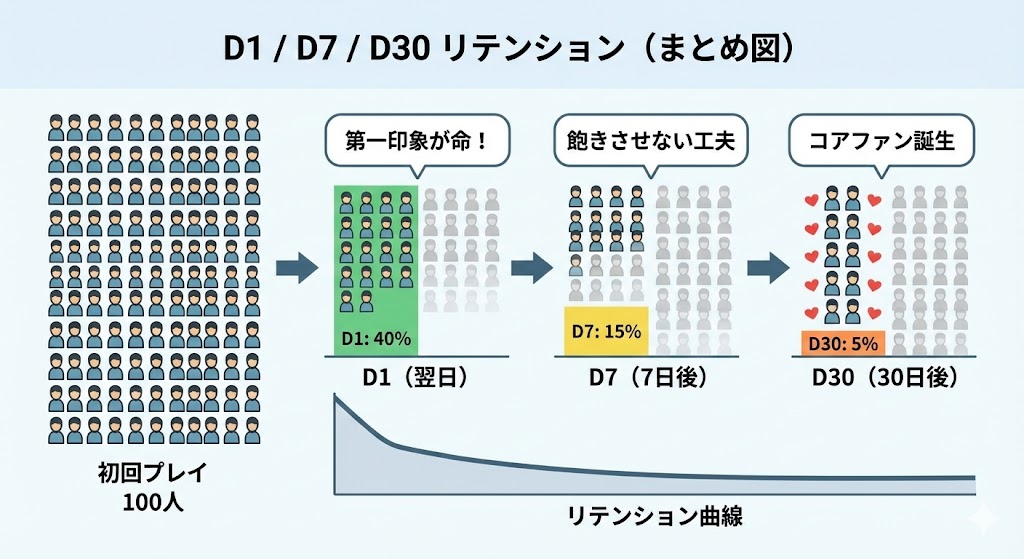
Roblox median is around 35%, top 5% over 60%. RPGs trend higher, Obbys lower. Treat 35% as a first checkpoint, then climb in steps — 45%, 60% — as you ship improvements.
Marsh
Why does the first 30 seconds get talked about so much?
Mallow
Because that's when most quitters quit. Roblox audiences are TikTok-conditioned — slow openings burn through patience. The core loop has to be touchable in the first 30 seconds, ideally with one action of agency before anything explanatory.
Marsh
What kinds of changes actually move D1?
Mallow
Two layers. (1) Make the first session land — tutorial design, the first 30-second hook, surfacing the core loop early. (2) Hook for return — daily rewards, streaks, push notifications, "tomorrow's limited" teasers. The second layer only works if the first one already does.
Formula & benchmarks
D1 Retention = Unique returning users on Day 1 ÷ Unique users on Day 0
- Under 25%: First session isn't landing — tutorial / first-30s rework needed
- 25–40%: Roblox median range
- 40–55%: Strong — top quartile
- Over 60%: Top 5% — typical of habit-forming RPGs and well-tuned Simulators
Worked example
Marsh
We had 1,000 first-time visitors yesterday. 280 of them came back today. D1 is 28%, right?
Mallow
Right. Below median. First-session problem, almost certainly.
Marsh
How would we diagnose where in the first session people drop?
Mallow
Funnel events at each tutorial step. "Spawned → moved → first interaction → first reward → tutorial complete." Plot the drop between each. The biggest cliff is your target.
Marsh
If we got D1 from 28% to 40%, what does that buy us?
Mallow
Two things. (1) ~43% more day-2 actives from the same acquisition. (2) The algorithm sees better engagement and serves you more impressions — which compounds. D1 is one of the highest-leverage numbers you have.
Reading it in Roblox
Creator Hub Analytics shows D1 directly in the Engagement section, broken out by acquisition source (Home, Search, Friends, etc.). The source split is the most useful part: discovery-page traffic is generally lower-intent than search or friend-invite traffic. If your headline D1 is dragging, check the source split first — sometimes the average is fine but one channel is collapsing.
Common misconceptions
- "D1 is low so the game is bad" oversimplifies: D1 is highly dependent on traffic-source mix. A wave of cold-traffic discovery clicks will tank D1 without your product changing.
- D1 isn't always 24 hours: Some platforms define D1 as "calendar day 1," others as "24h from first session." Confirm Roblox's definition (calendar-day based) before comparing across sources.
- Pushing D1 with daily rewards alone doesn't stick: If the first session doesn't make people want to return, bribing them with login bonuses just delays churn by a day.
Related metrics
- Day 7 / Day 30 Retention: Mid- and long-term retention, driven by different mechanics
- Session Length: If D1 is low, first-session length helps isolate the cause
- Churn Rate: D1 Churn = 1 − D1 Retention, the same number from the other side
- Cohort Analysis: D1 by cohort separates product wins from traffic-mix shifts