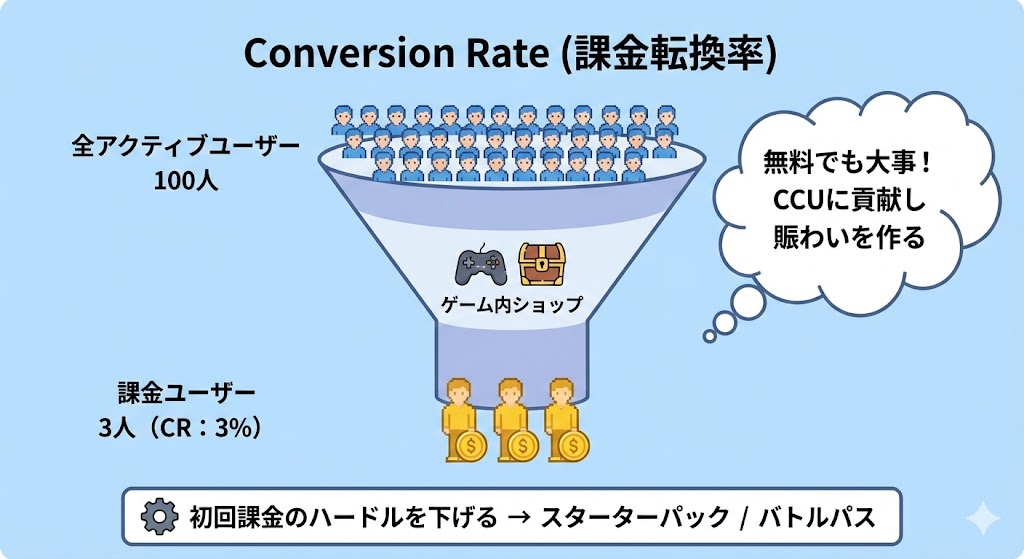


Width of the funnel
Marsh
Conversion Rate is just "share of people who paid." Are there really that many paying players on Roblox?
Mallow
Average 1–3%, top titles around 8%. 1–3 in every 100 actives paid. Sounds small, but for F2P that's typical.
Marsh
Is 2% the same kind of thing as e-commerce conversion?
Mallow
Same math, different population. E-commerce 2% is "of visitors." Roblox 2% is "of actives" — people who already engaged enough to play. For comparison, well-merchandised UGC item shops on Roblox can clear 3–5%. Branded experiences usually sit at the lower end.
Marsh
How do you push it up?
Mallow
Three big moves. (1) First-purchase offers — "50% off your first buy" — lowers the first barrier. (2) A strong low price tier: 30–80 Robux items ($0.40–$1) for the trial spenders. (3) Reduce friction in the purchase flow — buried buttons don't get clicked.
Marsh
Between ARPDAU and Conversion Rate, which should I prioritize?
Mallow
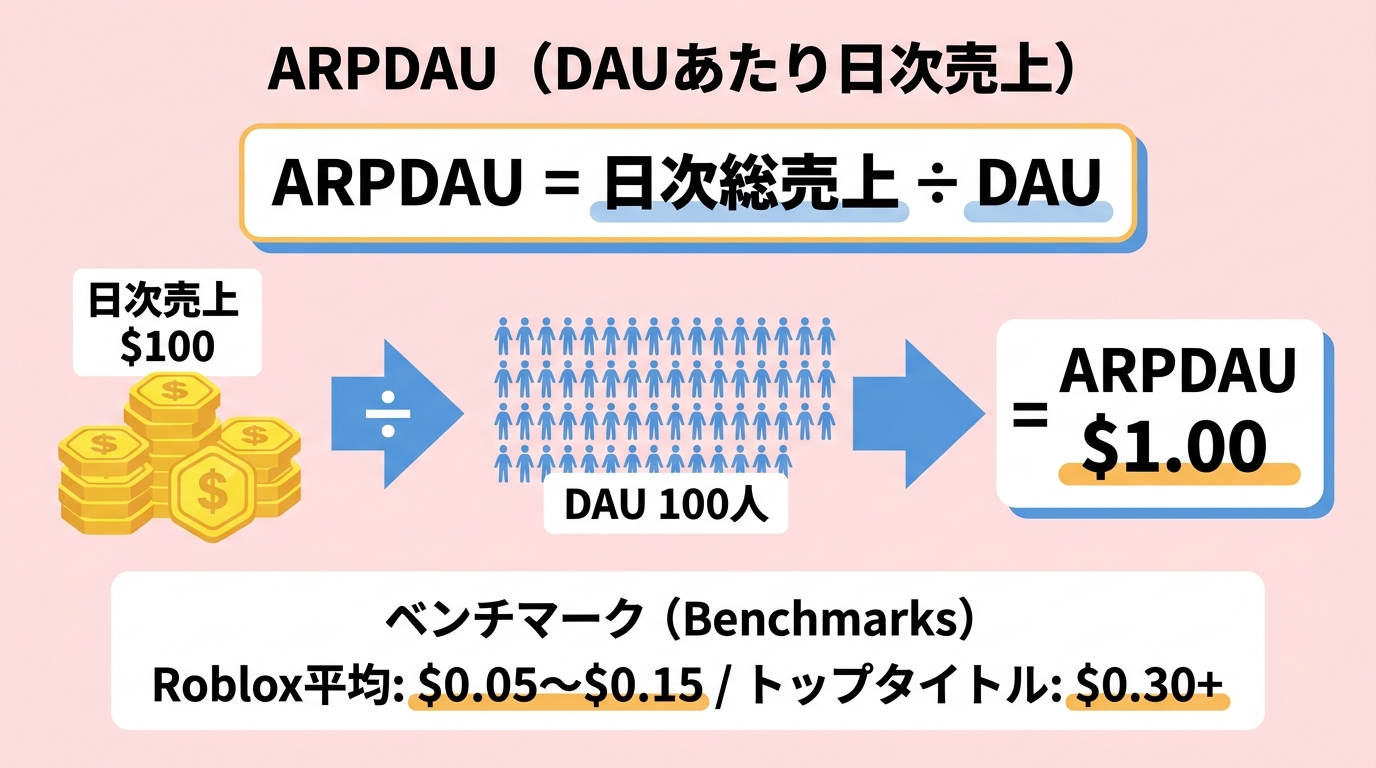
Both. ARPDAU = Conversion Rate × payer ARPDAU, so if ARPDAU is low, you can ask whether the bottleneck is width (CR) or depth (revenue per payer). Low CR → fix the entry. Low payer spend → ship high-tier content.
Formula & benchmarks
Conversion Rate = Paying users ÷ Active users
ARPDAU = Conversion Rate × payer ARPDAU
ARPDAU = Conversion Rate × payer ARPDAU
- Under 1%: Purchase flow is broken or pricing doesn't fit the audience
- 1–3%: Roblox median range
- 3–5%: Strong — typical of well-merchandised UGC shops and Simulators
- Over 5%: Top tier (top is around 8%)
Worked example
Marsh
Our brand experience has 2,000 DAU. Last month we had 60 unique payers. What's our Conversion Rate?
Mallow
Watch the denominator. CR over DAU is one thing — but the standard cut is payers ÷ MAU for monthly CR. If MAU is 15,000 and payers were 60, monthly CR = 0.4%. Well below median.
Marsh
If we doubled CR to 1%, what happens to revenue?
Mallow
All else equal, revenue roughly doubles. 120 payers spending the same average buys you 2× the monthly total. That's why CR fixes are usually the cheapest revenue wins for under-monetized experiences.
Marsh
What's the first thing to ship for that lift?
Mallow
A 49 R$ starter pack triggered after tutorial. Single biggest lever for first-time-payer rate. The hard part is the trigger placement — too early they haven't engaged, too late they've already churned.
Reading it in Roblox
Creator Hub Analytics shows total payers and DAU/MAU. Divide manually for CR. Important caveat: Roblox counts a “payer” as anyone who spent in your experience during the window — so a 49 R$ buyer and a 5,000 R$ buyer count the same. To split width from depth, pair CR with ARPPU (revenue ÷ payers). External tools like RoMonitor surface payer cohorts and first-time payer rate separately, which is more actionable than monthly aggregate CR.
Common misconceptions
- "Higher CR is always better" isn't always true: A CR spike from a steep discount can drop ARPPU even more, lowering total revenue. Read CR × ARPPU together.
- Daily CR and Monthly CR are very different numbers: Most payers don't pay every day. Monthly CR is usually 5–10× daily CR. State the window.
- Brand experiences shouldn't blindly target 5% CR: If the goal is brand exposure and the monetization is light by design, a low CR is fine. Align with the business goal first.
Related metrics
- ARPDAU: Width × depth combined
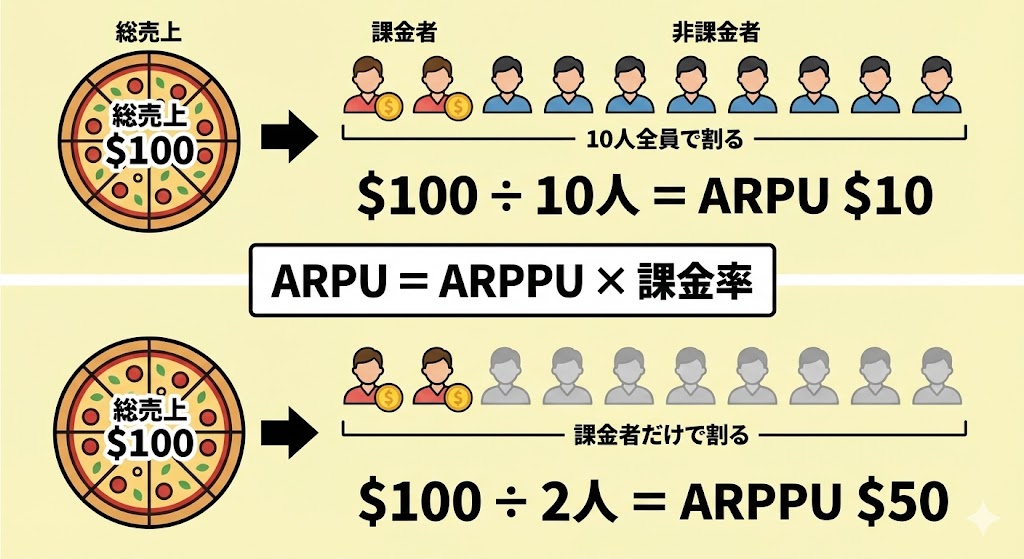
- ARPPU (Average Revenue Per Paying User): ARPU among only payers — the depth measure
- LTV: Splitting LTV by payer/non-payer clarifies where to invest
- First-Time Payer Rate: The leading indicator for CR growth among new arrivals