


Marsh
Mallow, Roblox put out something about buying a bunch of AI companies and a thing called "Roblox Reality" — photorealistic worlds. Is this another metaverse buzzword, or does it actually touch my planning?
Mallow
Both, honestly — it's a real strategic move and it's years away from your planning. Let's be precise about what happened. On June 3, 2026, Roblox announced it had acquired Morpheus AI's team and technology, and separately brought on the founders of Dynamics Lab and Lucid AI. It's a concentrated hiring-and-technology bet to accelerate a vision they're calling Roblox Reality.
Marsh
Who are these people, and why should a marketer care who Roblox hired?
Mallow
Because the names tell you the direction. Xun Huang, the researcher who founded Morpheus AI, invented something called "Self Forcing" — a way to turn slow, offline video-generation models into fast, interactive ones. Joe Chen of Dynamics Lab built a real-time generative "world engine" — upload an image, get an interactive world. Alberto Hojel of Lucid AI built what Roblox calls a "game cartridge harness" that bolts deterministic game logic onto video models. Chen and Hojel actually joined back in late 2025. Translate all that to plain language: Roblox is assembling the people who make generative video fast, interactive, and rule-bound enough to be an actual game.
Marsh
Okay, so what is "Roblox Reality" supposed to be when it grows up?
Mallow
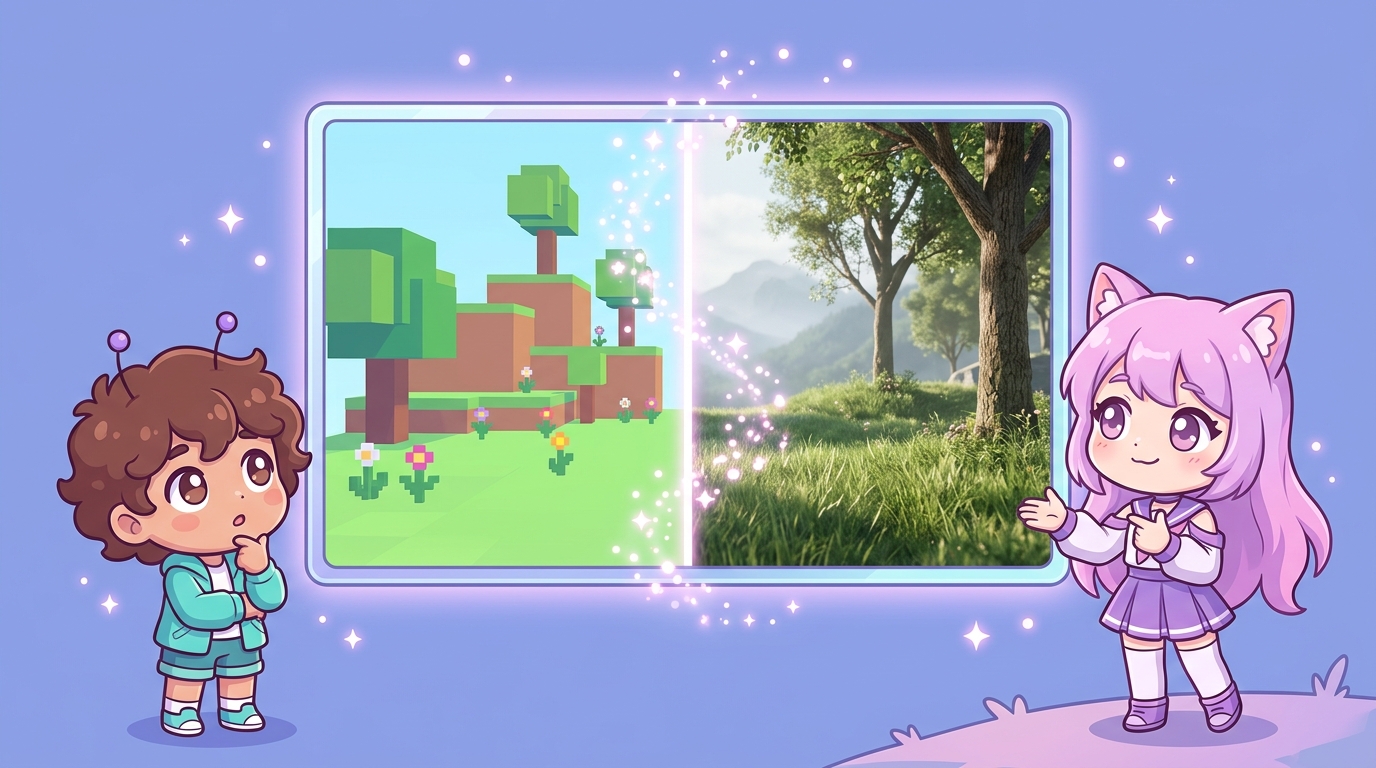
The goal is to fuse the Roblox Engine's structured simulation — the deterministic, rule-based world you already build in — with generative video models that paint photorealistic imagery. The target they put on paper is consistent, photorealistic, multiuser worlds — and the June 3 announcement raised the bar to 4K resolution at 60 Hz, up from the 2K/60 Hz development goal stated in April's Hybrid Architecture post. Roblox frames it as: "the integration of game engine and video models is the missing piece to unlocking consistent photorealistic multiuser worlds."
Marsh
Hold on. Roblox is famous for looking blocky and toy-like. Photorealism is the literal opposite of that. Why the U-turn?
Mallow
It's not a U-turn, it's a widening. The blocky, accessible look is Roblox's reach — hundreds of millions of users, runs on a phone. They're not abandoning that. Roblox Reality is a parallel track for high fidelity, and it builds directly on the Hybrid Architecture they announced on April 30, 2026. The thesis: keep the accessible engine, and open a path to console-grade visuals for the experiences that want them.
Marsh
Why would fidelity matter to a brand specifically?
Mallow
Because the single most common objection I hear from premium brands is some version of "it looks too toy-like for us." A spirits house, a luxury car, a fashion label — they've spent decades controlling exactly how their product looks, and blocky cubes are a hard sell to that legal-and-creative committee. If photorealism becomes achievable on Roblox at scale, that objection weakens a lot. And notice it rhymes with the other recent move — Roblox raising the DevEx rate 42% on adult US spend. Same compass heading: higher fidelity, more grown-up content, more premium money.
Marsh
Great — so can we build a photorealistic experience for our next campaign?
Mallow
No. And this is the most important sentence in this whole conversation: Roblox Reality is a vision and a research direction, not a product you can use. What was announced is talent and technology — people and patents, essentially. There's no creator-facing tool, no SKU, and no release date. If a vendor pitches you a "photorealistic Roblox experience powered by Roblox Reality" this quarter, that's a red flag, not a capability.
Marsh
Then why are you spending my time on something I can't use?
Mallow
Because direction is a planning input, even when the product isn't. It tells you where the platform's ceiling — and the audience's expectations — are heading over the next two-to-three years. The brands that quietly build their Roblox muscle now, on today's engine, are the ones positioned to move fast when fidelity actually ships. You don't wait at the station for a train with no timetable, but you do note that the line is being built.
Marsh
What's the danger of over-reacting to this?
Mallow
Three. (A) Don't freeze or delay a current project waiting for photorealism — that's betting budget on a roadmap. (B) Don't assume the blocky aesthetic is going away; it's the reach, and most successful brand experiences today lean into it rather than apologize for it. (C) Generative photorealism opens real brand-safety, IP, and moderation questions — when worlds are AI-generated, who guarantees your logo isn't next to something you'd never approve? Those governance questions will matter to your legal team long before the pixels do.
Marsh
So is there anything I should actually do today?
Mallow
Modest things. Put "Roblox Reality" on your watch list and check it at your next quarterly review. If you're already weighing Roblox, this lowers the long-term risk that the platform stays visually beneath your brand — a mild point in favor of starting. And bank the strategic read: Roblox is deliberately climbing the fidelity-and-maturity ladder. Plan for the Roblox of three years from now to look more capable and more adult than today's.
Marsh
…Executive summary?
Mallow
(1) On June 3, 2026, Roblox acquired Morpheus AI's team and tech and added the Dynamics Lab and Lucid AI founders, to accelerate "Roblox Reality." (2) The vision: fuse the structured Roblox Engine with generative video models for consistent, photorealistic, multiuser worlds at up to 4K/60 Hz, building on April's Hybrid Architecture. (3) It is a direction, not a product — no tool, no date, so don't replan around it. (4) Read it as a signal that fidelity and maturity are rising; track it, keep building on today's engine, and start asking the AI-content governance questions now.
Marsh
So the headline isn't "build photorealistic today" — it's "the platform my brand kept calling too blocky is openly trying to stop being blocky." That I can put in a deck.