Table of Contents
Introduction
As 2025 enters its final stretch, Roblox has released a series of important announcements that directly impact creators and studios. This week focuses on the year-end Creator Roadmap recap, the full rollout of new public publishing requirements, major upgrades to revenue analytics, avatar rendering optimizations, and improvements to Home and Search discovery. This article summarizes what has changed and how these updates may affect development, operations, and monetization—especially from a creator’s perspective.
Creator Roadmap Year-End Update: Priorities and Schedule Adjustments Toward 2026
“Creator Roadmap: 2025 End of Year Recap” Released — 39 Features Shipped and 2026 Timeline Revisions
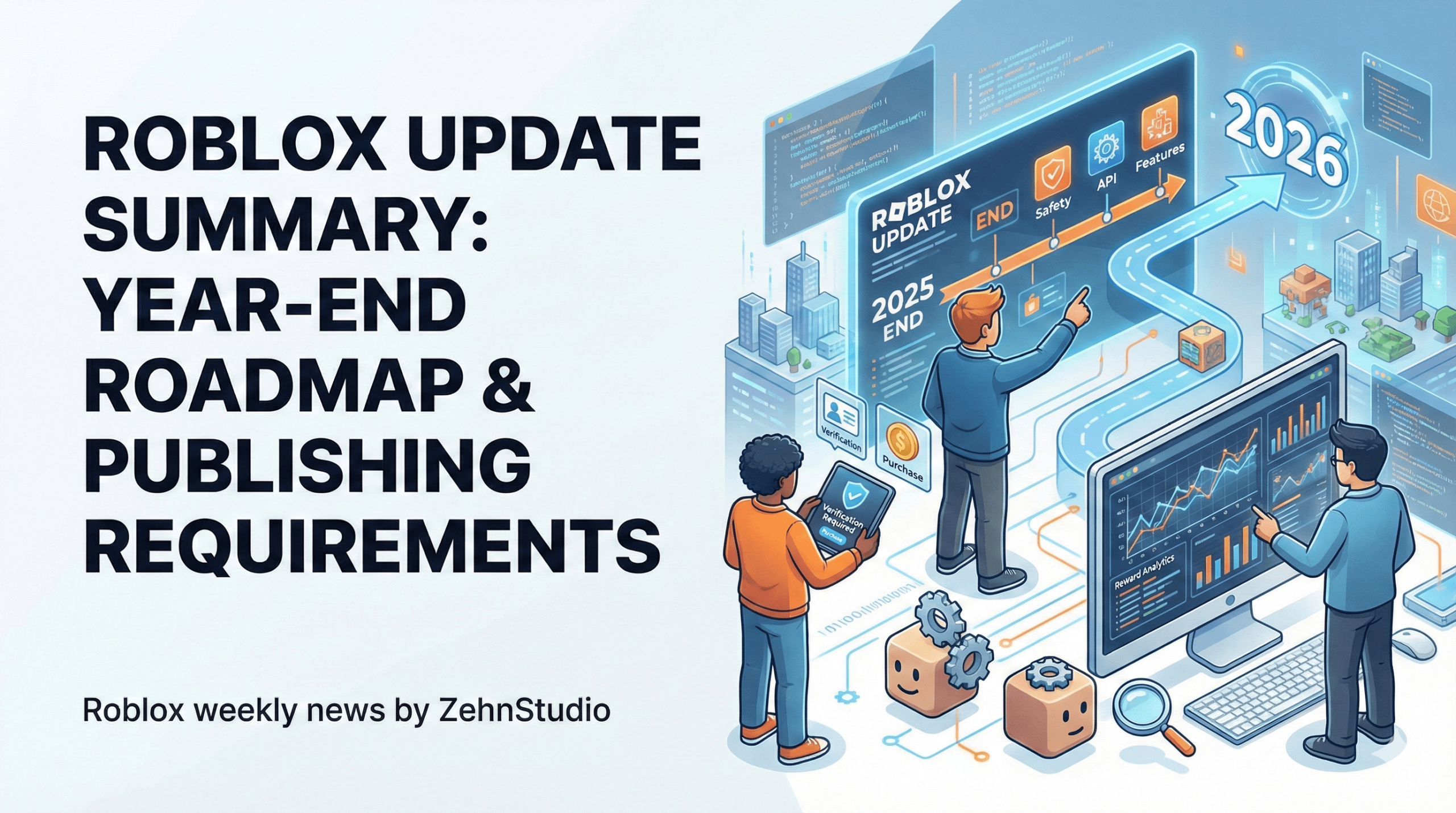
Roblox published the “Creator Roadmap: 2025 End of Year Recap” on the Developer Forum, summarizing progress made this year and outlining adjustments heading into 2026. Since the fall update, more than 1,400 bugs have been closed and 39 new features have shipped. Key highlights include Custom Matchmaking, which allows per-experience tuning to optimize engagement, and in-experience and matchmaking experiments that enable A/B testing to measure causal impact on player behavior.
Additional updates include regional pricing for developer products, the Reimport (beta) workflow that enables non-destructive asset updates from external DCC tools, and expanded light range limits up to 120 studs. Reimport is particularly impactful for daily production workflows, as it allows creators to update models while preserving rigs, materials, and colors.
Safety and moderation initiatives were also emphasized. Roblox shipped over 150 safety-related updates in 2025 alone, with upcoming work focused on automated scanning of avatars and scenes, stronger age verification for chat and Team Create, and improved alignment with IARC ratings. Several major features—such as Acoustic Simulation and the Text Generation API—were rescheduled to early or mid-2026, reinforcing Roblox’s priority on stability and quality. Developers should revisit their own roadmaps accordingly.
Full Rollout of New Publishing Requirements: A New “Entry Ticket” for Public Experiences
“New Requirements to Publish and Update Public Experiences” Updated on December 17
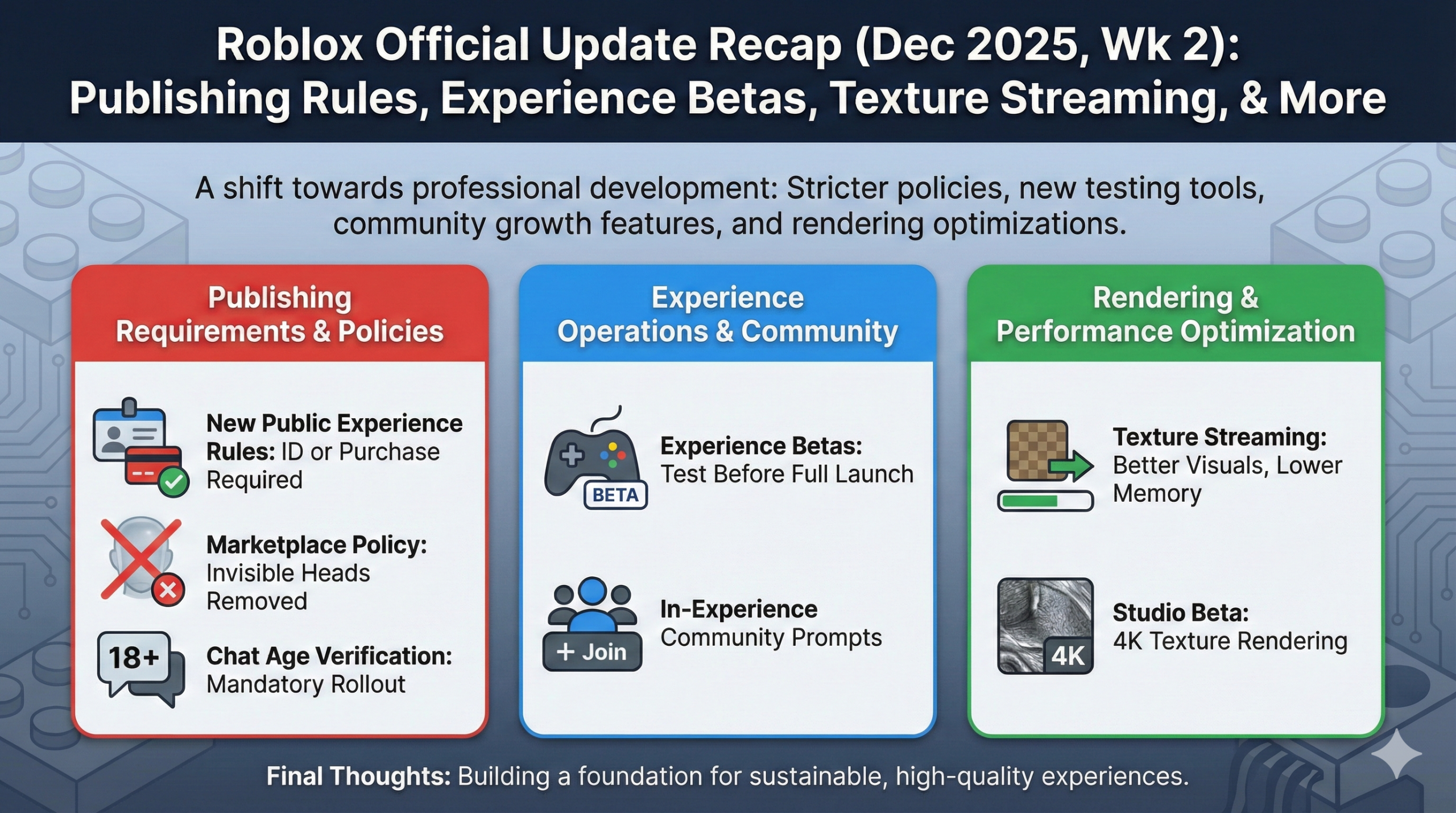
The previously announced requirements for publishing or updating public experiences officially began rolling out on December 17 and are now applied to all creators. To publish or update an experience set to Public, creators must meet at least one of the following conditions:
- Complete ID Verification
- Have made a real-money or gift card purchase since January 1, 2025
To minimize disruption for existing creators, Roblox introduced exemptions for accounts that either (1) generated over 100 hours of playtime between November 9 and December 10, 2025, or (2) successfully completed DevEx within the last 12 months.
The primary goal of this change is to reduce spam, copy games, and automated uploads from malicious accounts. However, it does slightly raise the barrier for new creators. Completing ID verification early and maintaining account trustworthiness is now more important than ever.
Community feedback has noted that these measures alone may not fully deter bots. Roblox responded by stating that requirements for UGC avatar items, the Creator Store, and Communities will also be reviewed to create a simpler and more consistent policy framework. Going forward, an implicit account trust score is likely to play a larger role in publishing and monetization.
Creator Rewards Analytics Improvements: Understanding “Why” Revenue Grows
“Introducing New Creator Reward Analytics: Better Data, Better Decisions”
Since the introduction of Creator Rewards in July—replacing the former EBP system—many experiences have seen revenue increases. Roblox has now released enhanced analytics to better understand the underlying drivers behind that growth.
- Reward Penetration Metrics
Track the percentage of DAU earning rewards, as well as how many new or reactivated users are directly tied to rewards, helping distinguish between organic growth and design-driven changes. - Flexible Time Granularity
Charts can now be viewed by day, week, or month, making it easier to compare short-term events with longer-term trends. - Enhanced Annotations
Creators can add custom notes for events like updates or seasonal content, allowing revenue, DAU, and conversion changes to be interpreted in proper context.
The Creator Hub’s Share Links page was also updated to track clicks, rewarded sign-ups, and reactivations from external marketing sources. This makes it significantly easier to evaluate influencer campaigns and paid promotions, and to justify marketing ROI with concrete data.
Avatar Rendering Performance Improvements: FastCluster and Layered Clothing
“Making Avatar Rendering More Performant” Addresses Frame Drops
Roblox detailed significant improvements to avatar rendering performance, particularly around FastCluster and Layered Clothing. Previously reported frame drops—triggered by actions such as highlighting avatars, seating, welding, or equipping tools—have now been substantially reduced.
These improvements are already live and require no changes to game code. Further optimizations are planned for early 2026 to reduce frame drops caused by Layered Clothing fitting. Games with heavy customization systems should see smoother interactions during equipment changes.
Roblox also outlined future plans to reduce FastCluster rebuild triggers, such as changes to color or transparency. This will allow developers to experiment more freely with visual effects while maintaining stable performance.
Home & Search Discovery Updates: Optimizing Retention and Genre-Based Discovery
Small Update Added to “Building the Future of Roblox Home and Search”
While less flashy, updates to Home and Search play a critical role in player retention and discovery. A December 12 update introduced two notable changes.
First, the Continue row on Home now permanently reserves the first two slots for the two most recently played experiences. This makes returning to a game frictionless and may positively impact returning user retention.
Second, the Search landing page now includes one-click genre tags, allowing players to browse experiences by category more easily. Experiences with clear genre positioning can benefit by aligning thumbnails, titles, and tags accordingly.
Although these changes are subtle, discovery and retention mechanics tend to compound over time. Developers should proactively consider how their experiences are positioned within specific genres.
Conclusion
This week’s updates feel less about introducing flashy new toys and more about laying a solid foundation for 2026. The year-end Creator Roadmap recap shows steady progress in tooling and operations, while also making it clear that stability and quality take precedence over rushing major features.
For developers, the short-term focus should be adapting to new publishing and safety requirements. In the mid-term, leveraging Creator Rewards Analytics and experimentation tools to understand cause-and-effect relationships in monetization will be critical. With major upgrades to avatars, engine performance, and discovery expected in 2026, investing now in analytics infrastructure and operational workflows will directly translate into long-term growth.